Maternal health refers to a woman’s health during preconception, pregnancy, childbirth, and the years immediately following pregnancy. Complications related to pregnancy, childbirth, and the postpartum period (6 weeks to 12 months after childbirth) have led to devastating health outcomes for many mothers in the United States.
The United States currently has the highest maternal mortality rate of any high-income country, with the number of maternal deaths estimated at more than 1,000 per year.
What are maternal mortality and morbidity?
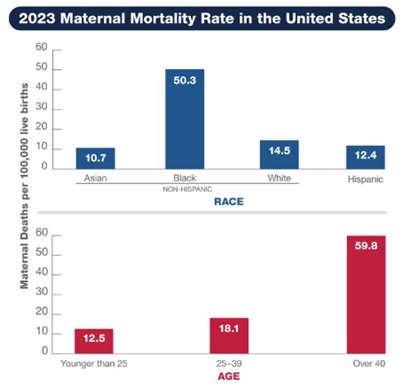
Maternal mortality refers to the pregnancy-related death of a mother, either during the pregnancy or up to a year after the baby is born. The U.S. maternal mortality rate has doubled in the past two decades. Within those statistics persist substantial ethnic and racial disparities, regardless of a mother’s socioeconomic status (such as income or education). For example, in 2023, the maternal mortality rate for Black women was significantly higher than the rates for White, Hispanic, and Asian women. Black women are 3 times more likely to die from a pregnancy-related cause compared to White women. American Indian/Alaska Native women also are disproportionately affected by maternal mortality.
In 2023, the maternal mortality rate for women over 40 was nearly 5 times higher than for women younger than 25; it was more than 3 times higher than the rate for women between 25 and 39 years old.
Maternal morbidity refers to pregnancy-related health conditions. Black and American Indian/Alaska Native women are at greater risk of these complications, including preeclampsia, gestational diabetes, and cardiomyopathy, compared to other women.
These health conditions can affect not just pregnancy outcomes, but also the long-term health of mother and child. For example, the NHLBI-funded study nuMoM2b found that women with any adverse pregnancy outcomes are at higher risk of hypertension within just 2 to 7 years after giving birth. Other NHLBI-funded research found that preeclampsia was linked with an increased risk of stroke later in life.
What research does the NHLBI support to improve maternal health?

Select each program or study to learn more. Explore the NHLBI maternal health research for more details on these programs.
- The Maternal Health Community Implementation Program (MH-CIP) promotes maternal heart, lung, blood, and sleep health through academic and community partnerships.
- Implementing a Maternal health and PRegnancy Outcomes Vision for Everyone Community Implementation Program (IMPROVE-CIP) focuses on issues that contribute to maternal death and severe illness.
- The nuMoM2b Heart Health Study is examining the effects of pregnancy complications on future maternal cardiovascular health.
- The Early Intervention to Promote Cardiovascular Health of Mothers and Children (ENRICH) addresses cardiovascular health disparities in mothers and children.
- The Chronic Hypertension and Pregnancy (CHAP) clinical study focused on improving pregnancy outcomes for women with mild chronic hypertension.
Why is the NHLBI focusing on maternal health?
The NHLBI is the nation’s leader in research aimed at preventing and treating cardiovascular disorders, a major cause of deaths and health conditions linked with pregnancy. Research is key to addressing the alarming statistics on maternal mortality and morbidity in the United States. The NHLBI plays a major role in advancing research to improve pregnancy outcomes, particularly those related to cardiovascular health.
What are some causes of the maternal health crisis in the United States?
NHLBI-supported research has provided valuable insights on the causes of high maternal mortality and morbidity in the United States. Mounting evidence points to cardiovascular disease as a culprit, with more women entering pregnancy with high blood pressure, obesity, and diabetes.
Women are also becoming pregnant later in life, after they are more likely to have developed age-related cardiovascular risk factors. For example, pregnancy after 40 can increase maternal cardiovascular risk and the risk of complications during and after pregnancy. Black and American Indian/Alaska Native women also are more likely to have cardiovascular risk factors before pregnancy, which contribute to poorer outcomes.
Differences in the environments where people live and work can further exacerbate maternal health disparities. For example, women living in regions with little to no obstetric care (known as “maternal health deserts”) experience higher rates of maternal mortality than women with better access. These deserts tend to be in rural areas, but can also exist in urban spaces. The longest travel distances to obstetric care are often in places where the population is predominantly American Indian/Alaska Native.
Researchers, including those funded by NHLBI, are also working to better understand how certain genetic factors may lead to increased risk of pregnancy-related complications, such as preeclampsia and postpartum cardiomyopathy.
Black Women and Pregnancy Complications
Listen to this episode of the NHLBI’s “Ask a Scientist” radio series to learn about maternal health disparities and why the provider-patient bond is so important in addressing them.
What should women do to have a healthy pregnancy?
Before, during, and after pregnancy, women can take steps to lower their risk of pregnancy-linked health problems. Learn about approaches that may help ensure a healthy pregnancy.
Where can I find more information on maternal health?
The NHLBI provides easy-to-understand information on pregnancy-linked health conditions. Learn more about pregnancy and specific health conditions.
Original Article – https://www.nhlbi.nih.gov/health/maternal-health